Skip

Climb up wherever you are. Your path is like a scrapbook, a handful of pages to revisit, decisions made, inadvertent high scores and lucky mistakes. What factors have brought you to where you are?

Orbital Logbooks allows you to browse through a collage of impressions that ten professionals from the field of education have collected over the course of a year in their field journals.

The journey is an infinite, circular itinerary, which we encourage you to follow as you like so that you lose yourself in the different stages that make up the landscape of empowerment.

Orbital logbooks
Empowerment is a continuous, infinite journey. The circle you will see next aims to be its representation. In it are situated, in the form of coloured circumferences, the different stages of the empowerment process that ten professionals in the field of education have defined with their thoughts and reflections. By selecting them, you will be able to see what stage they refer to and you will discover the materials made to describe it.

The different colours correspond to three types of resources:
The green circumferences contain pages from field journals.
The orange ones, audio-visual pieces on specific topics, recorded by the educators themselves.
The yellow ones contain fragments of four focus groups where participants shared experiences.

Through these materials, you will be able to delve into the meaning of a term as abstract and multifaceted as that of youth empowerment; circulating through its stages, from prior reflection to the evaluation of the results obtained.

In the menu on the top right, you can learn more about the project and also access an archive of the materials, where you can filter them by specific concepts and interests.
This page has been elaborated following the recommendations of the use of non-sexist language. Therefore, as far as possible, we have used generic expressions that include gender diversity.
SCROLL
|

“We’re Carme, David and Matilde. We’re part of Teleduca education and communication, an interdisciplinary team of professionals specialized in educommunication in community dynamization in Barcelona. Our work focuses on favouring situations of self-expression and meeting places, where young people take a leading role in participatory audio-visual creation processes.

We provide socio-educational and cultural support to young people of all ages and in very different situations. We act in formal and non-formal educational contexts and informal ones, and we even aim at recombining them. We encourage dialogue and the interrelation of young people with neighbours: the elderly, women's groups, local organizations, always with the idea of bringing the community together, addressing the feeling of belonging and establishing links with the immediate environment.”

June 3rd, 2019


Based on the results obtained in relation to youth empowerment, we want to point out a series of strengths and weaknesses that we have observed in the three projects analysed.

In search for development  

Strengths:

  • The fact that many of the young women in this project volunteered in educational leisure spaces was a positivevaspect, because they had a lot of interest and a strong motivation for the topic. We decided to take advantage of this and gave them the possibility to investigate their concerns further.

We saw a strong empowerment that spread throughout the group of participants (a large majority were girls, almost 90%) and they immediately took charge of the project themselves.

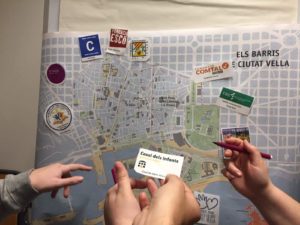
  • The students were in charge of making the different parts of the audio-visual map, they worked as a team and quickly learned how to use the different tools. They were responsible and confident in their decision-making throughout the process.

 Weaknesses:

  • Since it was a project with few sessions and very spread out in time, there were occasions in which the students had exams and

there were quite a few absences in the sessions, which made it difficult to ensure the proper continuity of the project.

  • At times we lacked coordination with the educational team that managed the general development of the project. This generated certain frictions between these professionals and our team, but we were able to clarify them and find solutions in order to continue the process.

In the case of projects that involve coordination with educational teams or entities, we consider it essential to try to have an optimal relationship that allows the project to develop in the best possible way.

Therefore, it is important to ensure that no misunderstandings arise that could make working together even more difficult.


Geovivència
Strengths:

  • We observed a positive change in many of the young people who had started the sessions with an uninterested and uncooperative attitude. Throughout the sessions they showed a sincere interest in the topics researched and assumed an enthusiastic and active attitude.
  • Through the project, the students became involved in their neighbourhood’s issues, they got to know first-hand the realities that surround them but that they had never approached, and we observed a real empowerment when they took the reins of the study to ask about what intrigued and concerned them.
  • The students established a relationship with the entities and the people in their neighbourhood that transcends the duration of the project. We can observe the students’ empowerment in the pride they show for their video and in the way they debate and reflect on the topic under investigation in the different presentations of the audio-visual pieces that have been organized so far at the school, the neighbourhood and other spaces in Barcelona. 

Weaknesses:

  • The limited time available for the sessions generated difficulties in getting the students involved and committed, especially in the 

Culture and Values and Religion class, which only had ten 1-hour sessions that, due to external factors, were reduced to less. This generated discomfort among the students and a lack of motivation due to the tight deadlines.

  • Working in a high school context and within the curriculum sometimes caused apathy towards the project among the students. 
  • Working together with high school teachers sometimes complicated the relationship and direct contact with the students, and caused confusion and friction between our team and the students, especially in the case of a teacher who was not convinced that the video 

would be finished on time. But, in view of this situation, we decided to meet with the teacher and talk about the issue, and together we reflected on the best way to get organised and take advantage of the little time available. Thanks to a combination of online and face-to-face work, we were able to motivate the students to work hard in the final stretch and finish the videos.


In this sense a negative aspect was transformed into a positive one that helped youth empowerment in the last stages of the project.

Identity Lab
Strengths:

  • The youth were involved in the project from the very beginning. The fact that they could decide what they wanted to explain and how they preferred to express it, gave them a lot of peace of mind and freedom. We believe that this was key to the empowerment during the project.
  • They were proud of the work they did and wanted to present the results to representatives of institutions, heads of their schools, family and friends.
  • The empowerment gave them a confidence and security that allowed them to present their ideas and feelings with sincerity in front
  • of a camera and then deliberate about them. They shared fears, dreams and contradictions in lively discussions.

Weaknesses:

  • It is possible that, at times, the students’ empowerment had a negative side. When it came to the production of the final video, it was time to decide which parts of the footage gathered during the project would make the cut and which ones wouldn’t. Some of the students decided not to show part of their personal work in public.

Another weak point was that, having to adapt to the time restrictions and interests of the kids, in some sessions we were unable to work on what had been 

planned, and, in some cases, we had to change the dynamic on the spot due to a lack of attendance or a sudden change of idea. In the long run, this was counterproductive because some of the work on the script was not taken advantage of, because we were unable to film it. Also, by not being able to move forward in some sessions, the work was delayed and that took time away from the interactive editing sessions.

Teleduca; education in communication
#evaluation #metalearning #team_work #teleduca